



I recently went to buy a car for my family. Before even visiting the showroom, I planned my budget, the kind of car I wanted (Sedan, SUV, etc.), and the features I wanted in it. Once planned, I went to the showroom to finalize the one perfect for my use.
This is an example of micro-level research by a consumer. If a consumer can spend so much time and effort in such decisions, imagine the level at which companies need to think to grab their attention! Successful companies evaluate every last detail of their target market when developing sales and marketing strategies. This is market research.
To give you a better idea, let me share one such market research example. We have all seen the viral Lay’s Ketchup chips in Canada. Why do other countries not have it? Simple, Lay’s R&D team gets cues from market research to develop flavors depending on cultural tastes, culinary traditions, and ingredient availability. This makes the brand feel authentically local and drives sales.
In this blog, I will be briefly discussing what market research is, its benefits, how AI adoption in market research is changing the game, and most importantly types of market research.
What is Market Research?
Simply put, it is the process of gathering information about a company’s competitors and target audience. This information is then used to define the company’s aim, conceptualize methods, and finalize findings. This collected information can be varied in nature, like your customers’ preferences and needs, a comprehensive analysis of your competitors and their strategies, and upcoming trends in the market.
Recently, I have written about market intelligence, the broader term of market research. In that, you can read about how L’Oreal uses market research (TrendSpotter) to predict trends and cash in on them.
Benefits of Market Research in Understanding 2026 Trends
With solid market research, what you will have on your hands is correct, actionable, and relevant information. There are no guesses in business today, especially when 95% of market researchers are using AI-powered tools or experimenting with them. If you’re not on that bandwagon yet, let me share some market research benefits to inspire you:
It helps you to detect and understand your target audience. It designs comprehensive customer profiles by gathering data on their behaviors and requirements. By learning this, you can develop products that meet or exceed their needs.

Market research analyzes trends and your competitors to assist you in strategic planning. It also finds areas of growth that you can utilize to expand your business.
It also reduces risks taken in business by verifying ideas, products, and services through feedback forms, surveys, social groups, etc.
By incorporating market research in your routine, you can stay ahead in terms of shifting customer preferences, regulations, market trends, and competition.
Market Research Types: Benefits, Methods, Best Tools To Use
There are four vital market research methods. Below, I have mentioned them in detail along with their benefits and the best tools you can try out.
1. Primary Market Research
This type of market research is all about collecting data directly from the sources, first-hand data, to get insights about particular business needs. Businesses who are customer-oriented will use this method to get information about their customers. What do they want? Once you know the answer to this question, you can move on to: How can you provide them with it?
The primary market research requires effort, creativity, and initiative. But what you can get is highly useful – first-hand customer insights. Once you have this data, try to incorporate it into your business strategies as quickly as possible to gain access to an untapped market.
Methods of Primary Market Research
- Surveys, inexpensive way to collect a large amount of data.
- Interviews can provide extensive, personal views on customer needs and market gaps.
- Focus groups are a great way to collect large amounts of feedback, but they can have biases.
- Another is observational research, but it does not guarantee accuracy every time.
Benefits
- Customized Insights
- Personal Understanding
- Trends Identification
Tools for Primary Market Research
- Survey & Questionnaire tools include SurveyMonkey, Zoho Survey, and Google Forms.
- Interview & Focus Group tools include iTracks, Zoom, and Google Meet.
- Observation & User Behavior tools include PewResearch Center, Hotjar.
2. Secondary Market Research
You can also use previously available data, like some organizations’, to get insights on customer behavior, trends, and the overall market. For example, you can use the local or government census to get a general understanding. People who have kids in their homes are more inclined to visit your toy shop, so you can get an idea of who to target mostly.
Tough secondary market research is not as elaborate or effective as the primary one, but it is a quicker and more cost-efficient way of getting access to prospective customers.
Methods of Secondary Market Research
- Government reports can give you access to population demographics and financial trends.
- Academic papers are another way to get insights into specific subjects.
- Market studies give in-depth perspectives for benchmarking.
- Trade journals give information about what your competitors are up to and also developments within your industry.
Benefits
- Broad Insights
- Cost-Effective
- Saves Time
Tools for Secondary Market Research
- Tools for Data & Statistics are Statista, the Census Bureau, Pew Research Center.
- Tools for Competitor & Keyword Analysis are SEMrush and Ahrefs.
- Tools for Trend Tracking & Consumer Insights are BuzzSumo, Google Trends, and Answer the Public.
3. Quantitative Market Research
With quantitative market research, you can find measurable insights through statistical analysis and numerical data. It assists you in understanding behaviors and trends in large groups. You can poll hundreds of people at once and understand their needs by the poll results.
Methods of Quantitative Market Research
- You can use polls to prepare short, to-the-point questions for fast insights.
- You can design questionnaires to gather quantifiable information.
- In this type of research, too, you can use surveys to develop structured questions for comparable and compatible responses.
Benefits
- Metrics You Can Track
- Actionable Insights
- Statistical Consistency
Tools for Quantitative Market Research
- Survey & Data Collection tools include Qualtrics and Typeform.
- Data Analysis & Visualizations tools include Tableau and Quantilope.
- Digital Behavior & Analytics tools include Google Analytics and Brandwatch.
4. Qualitative Market Research
As the name might suggest to some, qualitative market research is quite literally getting into the customers’ heads, getting insights on psychological and emotional factors that drive decisions.
Not every buying decision can be calculated numerically; some depend on your customer’s emotional state. A comprehensive market research requires a multi-dimensional approach – answering the ‘why’ behind every purchase.
Methods of Qualitative Market Research
- You can conduct interviews to get detailed information.
- A focus group also helps you to collect varied opinions.
- By conducting open-ended surveys, you can get real, undiminished customer opinions.
Benefits
- Empathy Development
- Extensive Feedback
- Contextual Understanding
Tools for Qualitative Market Research
- Tools for Online Focus Groups & Interviews are Recollective and Zoom.
- Tools for Qualitative Data Analysis & Repositories are MAXQDA and Dovetail.
- Tools for Qualitative Surveys are Typeform and Qualtrics.
Related: Business Intelligence Tools of 2026: A Guide & Overview
Choose Market Research Techniques Based on Your Organization’s Goals
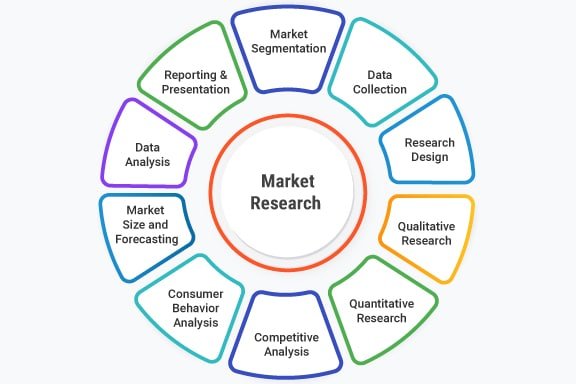
The best way to find your way through market research is to understand what your organization needs, its specifics. Here are some points that you need to keep in mind before delving into the world of market research.
Business Mission Identification
To ensure that your market research efforts are objective and focused, define clear goals. Having a goal in mind saves you time, money, resources and gives you actionable insights.
Complement Market Research Types To Goals
Choosing among primary, secondary, qualitative, and quantitative market research is also a task. When you have an aim, then aligning with the method of market research becomes easier.
Take Into Account Your Resources & Budget
As already discusses secondary research is cost-effective, while primary research can be high in expenses. Also, qualitative research can be scaled easily, while quantitative research can be demanding in resources and expertise. Know your objectives, resources, and budget to choose the best-suited one.
Mix Research Types For Comprehensive Outcome
By integrating multiple methods, you can maximize your insights. Like validating data, combining primary and secondary research, and addressing multi-dimensional challenges.
Successful Market Research Examples To Inspire You
As I have already shared the success story of Lay’s chips brand, similarly, many brands have utilized market research for growth and to drive sales.
An international beverage brand, Finlays, wanted to get a handle on evolving customer needs and market trends. They combined primary market research surveys with secondary market reports to get to know upcoming trending flavors, beverage preferences, etc. Then they developed products that met the standards of the current consumers.
To manage credit risk, insurance company Allianz incorporated primary market research in their business regime. They surveyed customers, got hold of competitor moves across regions, and modified risk models accordingly.
Turn Market Research Into Game-Changing Business Success
Today, the companies that are winning at their game are not just relying on intuition, but adopting modern market research types and AI tools to back their intuition with data.
Market research is no longer a gatekeeper subject; it’s more of an organizational capability. Market researchers are experimenting with various methods of research to ask bigger questions and move faster in the innovation cycle.
Related: Open Source Intelligence: Definition, Framework, Modern Applications