

Ever since witnessing the innovations in machine learning and artificial intelligence, we can’t stop discussing AI vs the human brain. Many intellectuals of the world have been working on Human-Aware AI, wherein AI is a fellow ‘team member.’ The aim is to make them at par with human team members, both in cognitive possibilities and limitations.
As of now, artificial intelligence is still in pursuit of the golden standard of intelligence, which is human-like intelligence. To work like humans, AI needs to imbibe certain qualities, such as sensing, understanding, and accomplishing complex behavioral traits, including motivation, emotion, and creativity.
But this situation is still nowhere on the distant horizon. No matter how autonomous and intelligent AI becomes, they are going to stay unconscious machines or purpose-driven devices that support humans in specific, complex, or repetitive tasks.
In this blog, I will be discussing the decade’s most debated topic, AI vs human intelligence, each of their special aspects, most functional features of the two, and who is the better one? Another provocative question that I’m coming across a lot nowadays is, should I switch to jobs that AI can’t replace? Obviously, we will be having a conversation about this, too.
AI Vs. Human Intelligence: Overview & Special Aspects
Let’s start with artificial intelligence:
It is the process of simulating human intelligence by machines, like computers. It requires the development of algorithms that assist machines in carrying out tasks that mostly require human intelligence, like learning, complex problem-solving, decision-making, and perception.
Let’s explore some branches of AI:
- Machine Learning or ML: It allows computer systems to go through huge amounts of data and learn from them to make decisions or predictions without the need for extensive programming.
- Deep Learning or DL: It automatically learns hierarchical data representations by using neural networks with various layers. This allows them to perform tasks like speech and image recognition.
- Computer Vision: It assists computers in understanding and transcribing visual data, like image categorization and object recognition.
- Natural Language Processing or NLP: It assists computers in creating and understanding human language, and helps with tasks like sentiment analysis and language translation.
Now, coming to human intelligence:
Human intelligence can perform varied cognitive tasks, like perceiving, understanding, solving complex problems, and reasoning. We also have the ability to understand right from wrong, have ethics, human emotions, and creative thinking.
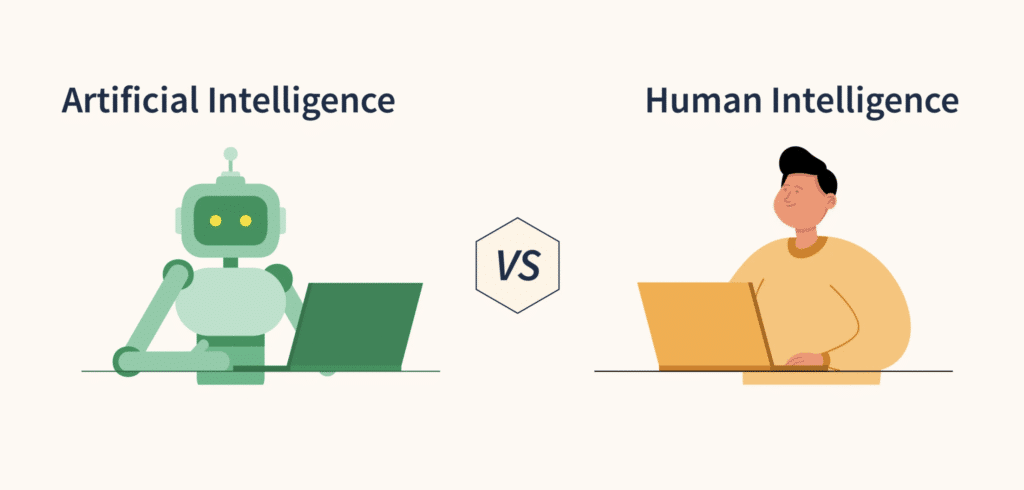
Let’s understand some of the abilities of the human brain:
- Reasoning: This aspect allows us to think logically, make decisions, and come to conclusions after going through available information.
- Creativity: It involves originality in thinking and imagination to discover great ideas, solutions, and artistic expressions.
- Perception: It involves the interpretation of sensory information from the surrounding environment, like smell, sight, touch, and hearing.
- Emotional Intelligence: This is the ability of humans to generate, manage, and perceive their own emotions. Also, it allows us to understand others’ emotions and empathize with their feelings as needed.
- Social Intelligence: It is the ability of humans to interact at a social level, mingle with people, perceive social cues, and adapt our behavior accordingly.
What are the Best Features of AI?
The learning of artificial intelligence involves algorithms, through which machines make decisions after training on huge datasets. Their ability to process information rapidly and learn from experiences has positively affected (mostly!) daily human lives. Some examples of AI at work include:
- Self-driving cars
- AI assistants like Alexa and Siri
- Recommendations on OTT platforms
And many more.
Some strengths of artificial intelligence are:
- When it comes to data processing, AI is much faster than human cognitive abilities. Tasks like predicting patterns and analyzing data become quicker.
- Like humans, AI don’t get tired or bored. This is why it is great for performing repetitive tasks with accuracy and consistency. AI achieves precision and reliability in varied tasks, from financial analysis to quality control, and everything in between.
- In recent years, AI automation has driven a wide range of innovations, like autonomous cars, chatbots, etc. These have not only reduced human labor, costs, and other factors but also improved productivity and streamlined workflows. It has also freed up time for humans to concentrate on more intelligent and bigger tasks.
What are the Best Features of Human Intelligence?
As aptly stated by Sherlock Holmes, “I am a brain, Watson. The rest of me is a mere appendix.” Human intelligence is not just about abrupt thoughts; it holds much greater ambitions. What makes us human? Our unique characteristics like creativity, emotions, empathy, ethics, principles, and knowledge beyond any set limit.
Our brain is not only suitable for calculations, formulations, but also for human experiences, like social connections, understanding others’ perspectives, and collaborating for the greater good. The world of now is shaped by centuries of meaningful human intellect, through arts, culture, scientific discoveries and inventions, and literature.
Some strengths of human intelligence are:
- Thinking outside the box is what we are amazing at. We use the limitless power of our brains to create ambitious ideas, come up with creative ways of doing things, adapt to new environments, and even think of changing the world for good! This constant creativity assists us in innovating and achieving breakthroughs in various fields of life, from scientific research to philosophy.
- What vastly differs us from machines is our ability to be emotional, empathetic, and understand others’ feelings. We are capable of social interactions that connect us, help us to work together, and even have relationships.
- What brought us to 2025 from our ape ancestors is our capability to adapt to changing surroundings, which we know as evolution. The human brain, the master of adaptability, helps us to learn from experiences, become contextually aware, and solve problems. This has made us highly resilient to changing times and situations.
Related: AI & Common Sense, Will This Union Ever Be Possible?
AI Vs. Human Intelligence: Quick Compare
Let’s compare AI and human intelligence on various features to understand how they differ from each other and in what ways they are similar.
| Feature | Artificial Intelligence (AI) | Human Intelligence |
|---|---|---|
| Meaning | Machine processing a massive amount of data and learning from algorithms to display intelligence | Humans’ inborn cognitive capabilities to think, connect, reason, etc., are based on emotions and experience |
| Nature | Simulative in nature, i.e., imitates human actions using the logic of computers | Adaptive to the environment; uses emotions, experience, and reasoning |
| Framework | Uses digital systems, neural networks, and ML algorithms to function | Uses cognitive procedures and biological neurons to function |
| Learns From | Data, training datasets, and feedback loops | Social interaction, environment, and experiences |
| Decision-Making | Data-powered and neutral, lacks emotions and ethics | Subjective in nature, as decisions depend on moralities, emotions, and logic |
| Creativity | No imagination, dependent on programmed limits | Can think innovatively, abstractly, and creatively |
| Adaptability | Dependent on training on new data | Natural adaptation to surrounding changes |
| Efficiency & Speed | High-speed data processing with fewer or no inaccuracies | Can be slower in function, but has excellent contextual reasoning |
| Accuracy | High accuracy, but dependent on the quality of data and the algorithm | Lower accuracy as it is dependent on biases, stress, tiredness, or emotional condition |
| Social Connection | Very low understanding of social emotions and cues | High emotional intelligence and social interaction |
| Multitasking | Not good, performs one or specific tasks efficiently | Easy multitasking, critical thinking, and working across different contexts |
| Limitations | Can work with precision and tirelessly | Requires food, sleep, and rest to function well |
| Ethics & Morals | No moral or ethical sense | Decisions can be dependent on ethics, morality, and conscience |
Jobs That AI Can’t Replace
Many manual jobs tend to be replaced by AI and humanoid robots in the near future, starting now. That’s enough reason for global panic among employees and workers. Students are now choosing courses that are more human-dependent. People who are entering professional life or already have a career are looking for ways to upskill. All these to avoid being displaced by robots and AI. But I’m going to share some AI-proof jobs that you can think about.
If you want to know in detail about how AI and robots are being developed to take over manual tasks for humans, read Top Robotics Companies That Will Lead the Market in 2026
According to the U.S. Career Institute, the following occupations will not only remain unaffected by AI but are going to grow in demand by 2031:
| Profession | Growth by 2032 (%) | Median Salary Annually (USD) |
|---|---|---|
| Nurse Practitioners | 45.70 | 120,680 |
| Mental Health Counselors | 22.10 | 48,520 |
| Athletic Trainers | 17.50 | 48,420 |
| Healthcare Social Workers | 11.10 | 60,840 |
| Soil and Plant Scientists | 9.10 | 66,750 |
| Psychiatrists | 8.70 | 249,760 |
| Physicists | 8.20 | 152,430 |
| Civil Engineers | 6.90 | 88,050 |
| Paramedics | 6.60 | 46,770 |
| Firefighters | 4.30 | 50,700 |
Many other professions require no blatant mentions, like police officials, surgeons, pediatric doctors, coaches, teachers, etc., who can never be 100% replaced by AI or other related technologies.
Finally, Is AI Better Than Humans?
Now, coming to the ultimate question, “Can AI replace human intelligence?”
Karim Lakhani, professor of Harvard Business School, has been studying the impact of machine learning and artificial intelligence at the workplace for several years. According to his experience, AI Won’t Replace Humans, But Humans With AI Will Replace Humans Without AI.
The integration of artificial intelligence by global companies and industries has heightened human expectations. Consumers want seamless experiences and improved AI-driven transactions. Why? Because it not only saves time, reduces errors, but also assists us in achieving tasks that seemed impossible even a few years back. So, the question of AI vs the human brain is not the right one to ask. Instead, world leaders need to focus on embracing AI, using its full potential, and developing successful use cases for business, not only for their own good, but for the greater benefit of humanity.
Related: What Is Paid Search Intelligence? Know All About It