



Strategic outcomes in businesses no longer depend on clever intuition; instead, they require ecommerce market intelligence to understand and deliver. You might be having an awesome product, but what’s next? To take your sales to the next level, smart marketing tactics must be combined with ecommerce competitive intelligence. Simply put, you need to grab hold of these 3 fundamental aspects:
- Customer behavior and preferences.
- Competitors’ activities.
- Market trends.
That’s exactly what we are going to learn today, what market intelligence is, how ecommerce market intelligence is vital today, some effective business intelligence in e-commerce tactics, and challenges you might face.
Defining Market Intelligence
Before understanding ecommerce market intelligence, we need to first know what the ecommerce market is going to look like in 2026. Here are some stats:
- As per the International Trade Administration, the B2B ecommerce market is expected to spike at a CAGR of 14.5% internationally in 2026.
- Some ecommerce trend highlights will be mobile shopping, virtual & augmented reality, voice search, AI, inclusive payment solutions, etc.
- Also, there will be special recognition for environmentally responsible and sustainable businesses.
The conclusion is that just like any other significant market, the ecommerce market is evolving with time. Market intelligence or MI assists in understanding the complicated aspects of this ever-evolving ecommerce market.
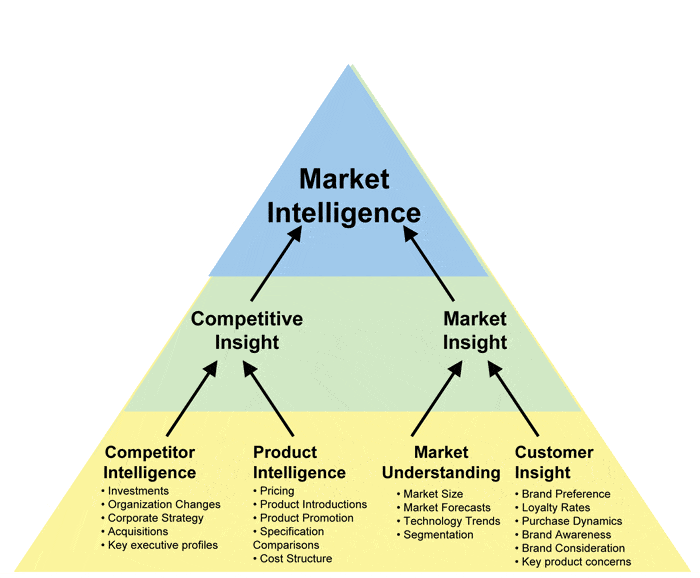
Market intelligence is the process of collecting, analyzing, and deciphering a company’s market data. This data typically includes customers, competitors, and market trends. MI plays a vital role in 2026 ecommerce businesses; help them navigate their environment and make strategic and informed decisions.
Ecommerce Market Intelligence Collects Data From 3 Areas:
- Customer behavior: The products and services most customers are inclined to buy, their buying patterns, and what they might need in the future.
- Competitor activities: Getting to know your rivals’ pricing strategies, marketing tactics, and product innovations.
- Market trends: Upcoming economic trends, shifts in customer behaviors, technological innovations, etc., shaping your industry.
How eCommerce Market Intelligence Can Help?
The most basic way market intelligence helps today’s businesses is by assisting them in making informed decisions. This involves helping them to anticipate future trends and market shifts instead of just responding to them. By incorporating ecommerce competitive intelligence, companies can detect and act on opportunities before any of their competitors.
Not just that, certain times come with challenges like stockouts, pricing issues, and shifting consumer needs. MI helps businesses to avoid these problems by staying proactive and informed.
The collected data from market intelligence provides insights to several departments of an organization, from R&D, price planning, to customer service, and advertising.
Related: Open Source Intelligence: Definition, Framework, Modern Applications
Some Effective Business Intelligence in eCommerce Tactics
1. Analysis of Customer Sentiment
Knowing customer sentiment is a vital way of driving growth in your business. You can do so by tracking feedback from multiple sources, like online reviews, social media channels, surveys, etc. They help you to judge how your customers feel about your brand, products/ services, and customer support.
Customer feedback directly benefits businesses to understand positive or negative points of customers and assists in future improvements. For example, negative sentiment often displays pain points of customers regarding product quality or poor customer service. On the contrary, positive feedback shows you the strengths of your business, like great customer service or an outstanding product feature.
According to Forrester’s US Customer Experience Index 2024, ‘customer-obsessed’ businesses showed 41% faster revenue increase, 51% improved customer retention, and 49% faster profit growth compared to businesses not claiming to be ‘customer-obsessed.’
Taking customer sentiment into account is your biggest passkey to faster growth. And incorporating AI and NLP technologies in sentiment analysis, like studying a huge amount of customer feedback in real-time, detecting tone, intent, and themes, will help to improve business decisions.
2. Monitoring Competitor Pricing
Competitive pricing ecommerce is another key aspect to stand ahead of your competitors. If ecommerce giants like Amazon offer a table for $300, you, as a competitor, should not price your tables higher than that. I would suggest that even a $5 lower price can make a huge difference. It is very basic to have a comprehensive understanding of your competitors’ price models to make your pricing strategies informed and data-powered. Even the smallest price difference can mean a lot to the customers, especially when the global economy is in shambles.
Adjusting your product prices dynamically helps businesses in 2 major ways:
- If your competitor is having a discount, you can either match the discount or lower the price of similar products.
- If your competitor is maintaining a product at one price for a significant time, you can stick to your latest price, taking advantage of this value-based position.
Businesses utilize real-time price tracking tools to gain insights into competitor pricing, promotions, and discounts. Often, these tools come with predictive analysis, when they predict future price fluctuations based on ecommerce historical data. These tools also consider customer demand, seasonality, and market conditions to suggest pricing adjustments accordingly.
3. Predicting Product Demand
By using ecommerce market intelligence solutions, businesses predict future product demand to stay affluent in the competitive market. Also, combining historical sales data analysis with the latest market trends, businesses can develop strategies in inventory, production, and marketing.
Inventory management optimization is highly dependent on accurate demand prediction. Incorrect prediction can lead to:
- Overstocking: Results in product waste and the tie-up of funds.
- Understocking: Results in dissatisfied customers and undersales.
Businesses use machine learning models to improve their demand forecasting. They are developed to adapt to consumer behavior and market changes in real-time, such as emergency events or economic changes.
4. Product Research of Competitors
Another aspect of ecommerce market intelligence is its ability to thoroughly analyze competitor product offerings. With this, you can successfully get insights into customer preferences and market trends.
This type of analysis consists of researching pricing, quality, customer reviews, types of products; a comprehensive understanding of how your competitors are placing their products in the market.
Another vital aspect of competitor product analysis is that it shows market gaps. That is, products your customers are looking for, but they’re not available with your competitors, or their products might lack a feature or two. You can use this gap to R&D a completely new product or tweak your existing one to better suit customer needs.
Analyzing competitor products also reveals potential areas of improvement within your company’s product offerings. Competitors’ customer reviews and feedback can show product and feature gaps. You can take these suggestions to develop product development strategies to meet market needs.
Many competitor analysis tools for ecommerce business are easily available to track price trends, product lines, and customer reviews in real-time. You can utilize them to refine strategies and identify growth areas.
5. Analysis of Geo-Market
Businesses use geo-market analysis to detect growth opportunities and challenges in different markets, locally, regionally, or globally. This enables them to tailor their products and promotions most engagingly.
Various markets differ from each other in ways like customer preferences, local laws and regulations, and market trends. Businesses analyze these factors to customize products, promotions, and payment options to enhance customer conversion and satisfaction.
Remember these focus areas when conducting ecommerce geo-market analysis:
- Track regional trends, like seasonal buying behavior, product trends, or customer buying patterns.
- Track purchasing patterns, like understanding specific areas’ economies and levels of disposable incomes. This way, you can price competitively and target the correct customer segment.
- Track customer preferences to localize product features, packaging, and even marketing campaigns to satisfy their specific tastes.
6. Analyzing Behavior of Website Visitors
Behavior analysis of your ecommerce website visitors tracks page views, time spent on particular sections, clicks, buying history, etc. This offers in-depth insights into your customers’ preferences and patterns. Using this data, you can design a more curated and targeted experience to grow conversions and engagement.
Some ways in which behavioral analysis can help you:
- By analyzing the products your customer adds to cart or wishlists, you can develop personalized product recommendations.
- You can also improve the site’s UI by understanding which sections are not much visited or where your customers leave their search.
- You can also improve your marketing efforts by knowing which products are selling the best or which pages are most visited. Design your campaigns accordingly.
- Customer behavior patterns also reveal when they are mostly on your website. Knowing this, you can optimize the timing and content of your brand marketing.
7. Industry Benchmarking
Benchmarking is analyzing performance data across various sections like pricing, conversions, operational efficiency, and customer satisfaction.
Time-to-time pricing reviews can show whether your product prices need better matching of the industry standard or customer expectations.
High conversion rates define optimized customer exploration or market-product fit. Benchmarking can show whether your business is lagging or not.
To understand whether your product is meeting customer needs, you must monitor customer reviews, feedback, and satisfaction scores.
Operational efficiency is a huge part of any business. Benchmarking helps you to understand any inefficiencies. If you need to be more cost-effective or need more agility in some departments.
Related: Business Intelligence Tools of 2026: A Guide & Overview
Combine eCommerce Market Intelligence with Technological Innovations
Ecommerce market intelligence is a smart and data-driven way of keeping your business not just floating but flourishing against competition. It’s about identifying the market, future trends, and most importantly, what your customers want today, tomorrow, and day after tomorrow.
By harnessing innovative technologies like AI and Voice of Customer (VoC) data from social channels, surveys, etc., you can have valuable insights into successfully running your ecommerce business. The recent boom of online shopping is a feeding ground for giant, medium, and small ecommerce companies. So, do not lose this opportunity. Instead, explore ecommerce competitive intelligence tactics to understand customers, bring in new ones, and never let go of the ones already loyal to your brand.