

Updations in the field of artificial intelligence are continuously changing how we interact with technology and even the world around us. But if we look closely, AI is not something new; it has been here for ages, just in different forms. This technology introduced itself as rule-based systems and programs like IBM’s Deep Blue. Later intelligence transformed healthcare by helping disease diagnosis, and other advancements like spam detection and filters, product recommendation, and more. Over the period of time, Siri was introduced into the daily lives of people.
In simple words, AI is not something new; what is new is its advancement and modern use. And one such example is generative AI, which, unlike traditional AI, does not just predict but creates. In this blog, we will decode generative AI in a simple way and understand how generative AI creates new content.
What is Generative AI & Its Technical Base?
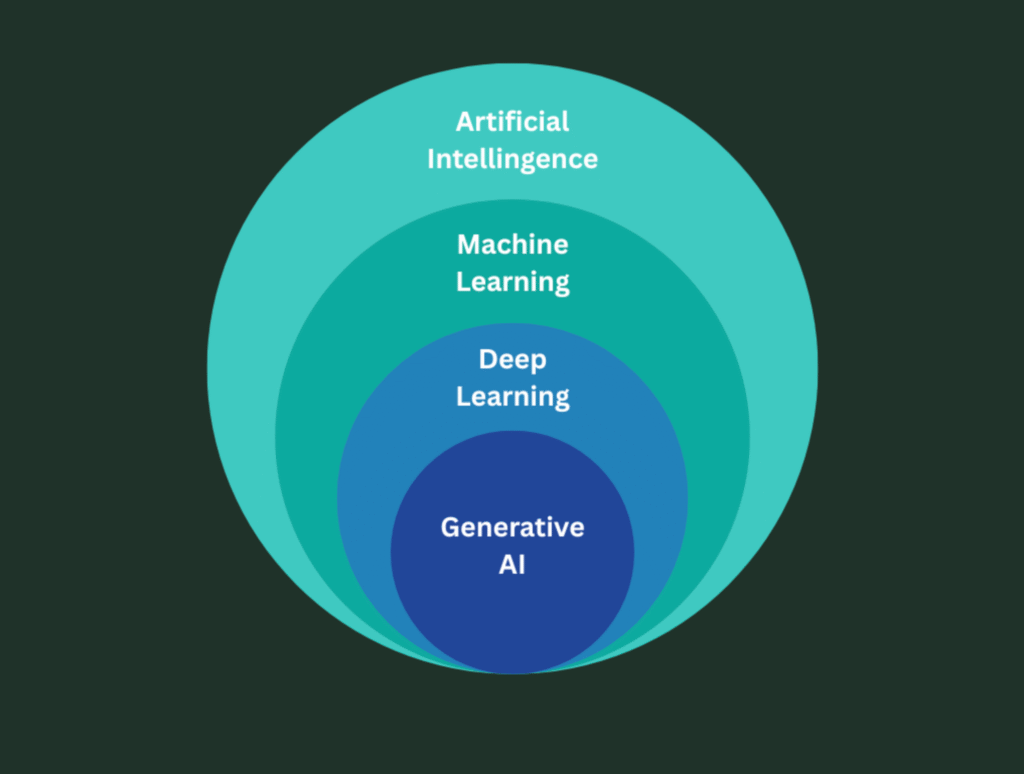
Under the tree of artificial intelligence, Generative AI is a subset of a subset of machine learning and is based on deep learning. As the word itself says, Generative means to generate or create something new. Therefore, it is a type of artificial intelligence that can make new things such as text, images, music, code, and more by learning from existing information and using it to create something new and different.
Related: Top 5 Market Intelligence Platforms for B2B Success
Technical Base of Gen-AI
By using the deep learning branch of AI, generative AI is trained on huge amounts of data of all types, including visuals, texts, sounds, code, etc. It studies billions of examples to learn. Then a neural network, which is like a brain of AI made of digital neurons (like brain cells), connects to understand and learn patterns to enable AI to predict and create things.
During training, the AI studies the prompt or say command given to it ( e.g., write a story about a newlywedded couple) and then it learns to predict what comes ahead and, using a feedback loop, keeps improving the output during training. A trained AI system is called a model; different models can be used to perform different tasks, according to the type or format of content.
GPUs power these systems, and cloud storage is used to handle training data. The special algorithms are set to make the AI stable and creative.
You can see Gen AI as a person who has studied every information available on the internet and now uses it to write, draw, or compose, but not copy; instead, learn patterns of creative frames from studied information.
Purpose of Generative AI
Unlike traditional AI systems, which are only capable of predicting things, Gen-AI is made to deliver creativity faster and efficiently. The main goals of generative AI are:
- Creativity – Help individuals across creative domains such as writing, designing, and art. Gen AI can be used as a teacher or coach to learn from and a tool to use when you are stuck in the process.
- Time Efficiency – Another important aspect of Gen AI is saving time by automating routine or boring tasks. For example, automation in the email-outreach process using AI in the link-building process. You can also learn about new agentic AI systems.
- Speed & Scalability – A task that can manually take 1 hour, Gen-AI can complete it in less than half the time.
- Easy Solutions – Coding is one of the prime examples. Some tools can generate code in minutes, which manually takes up hours of study and years of experience.
- Personalization – The most used element of generative AI across industries is to build brand and consumer relationships. Everything today is trying to be Made For You.
Difference Between Generative and Predictive AI
Traditional AI or predictive AI is making things easy with high efficiency by performing the same tasks over and over again. It studies the already existing information and tries to offer as accurate as possible forward looking insight as to what will happen next. Things like weather forecasting, stock prediction, fraud detection, and more. Predictive AI is great at performing one task at a time, and it is a master of one. It sticks to a set pattern of learning based on specific algorithms.
Whereas generative AI is about understanding the context of existing information and producing something new from it. It can handle multiple tasks at once, i.e., handling multimodal information. The learning style of generative AI is much more flexible and open, leading to highly creative solutions and outputs. Gen AI can write a script for your film while also composing music for it.
Related: What Is Paid Search Intelligence? Know All About It
Use Cases Of Generative AI
- Content Creation: AI can write books, blogs, articles, ad text, and also do copywriting for you.
- Video, Audio & Image Generation: With the help of generative AI tools/ platforms like DALL-E, Flow, Gemini 2.0, and more, you can create photos, videos, and music.
- Coding: By prompting, programmers can fix and improve code and even write small or full pieces of code.
- Research: Conduct full-proof research in less time, which allows you to summarize research papers, dump down reports, and more.
- Education: Create study material for students and form engaging learning methods like quizzes and more.
Benefits of Generative AI
- Creative edge
- Time saving
- Made for you approach
- Easy access to advanced technology & tools for everyone
- Cost cutting
- Supports evolution and innovation
Disadvantages of Generative AI
- Outcomes can be inaccurate.
- The training data provided can be biased, which may lead to stereotypes.
- AI-generated content is at high risk of copyright infringement.
- AI does not understand meaning since it just produces outcomes based on learned patterns.
- Though AIs are being highly advanced and trained on billions of parameters, the emotional replies they offer are logic-based.
- Privacy concerns and data breaches are another drawback.
Conclusion
Generative artificial intelligence has completely changed the use of AI in the digital world. From healthcare to the armed forces, it is everywhere. And the reason for it is its ability to generate new things from scratch. Whether it is music, code, a poem, a video, or an image, you can get it all done in a few minutes or even seconds. It is a union of creativity with efficiency in diverse sectors.
But there are both advantages and disadvantages of generative AI, and harnessing such advancement is about building a safe and transparent environment for the same. All in all, the futuristic approach towards AI must be about humans and machines creating wonders together.
Related: What Is Android System Intelligence? Features, Privacy & Full Guide
FAQs
- Are gen AI and machine learning different?
No, gen AI is a nested subset of deep learning. In simple terms, the hierarchy of artificial intelligence is: AI → ML → DL → Gen AI. - Why is Gen AI different from other AIs?
Gen AI is capable of creating new and original content from the learned patterns and studied information. - Can you generate code with Gen AI?
Yes, many generative AI models like GitHub, Copilot, Claude, and ChatGPT are used to code, fix bugs, and even teach programming concepts. - Can Gen AI replace humans in creative & software development jobs?
No, though it is a highly debated topic, looking at the broader picture, AI cannot replace humans because they are the ones operating it. There is a crucial requirement of human judgment, quality, ethical, and strategic checks. - Is Gen AI safe to use?
Yes, there are legal guidelines and regulations for the ethical and safe use of artificial intelligence.