

We have been hearing the phrase Jack of all trades, master of none, but oftentimes it’s better to be master of one. But in today’s scenario of machine learning and AI, I will help you understand the difference between Machine Learning vs LLM with the help of this phrase. And this phrase, i.e., who is the master and who is Jack. We will break down both the technologies and dig deep into their various aspects.
What is Machine Learning?
Classic Machine Learning is a way of teaching computers to learn and understand from data, unlike programming, where step-by-step instructions are given for any particular task. ML models are a set of algorithms designed to perform unique tasks; they are the masters of one. Techniques like neural networks, overfitting, supervised learning, reinforcement learning, etc, are used in machine learning to process and predict outcomes from data. They can handle various tasks like forecasting stocks, suggesting products, detecting anomalies, and much more.
Types of Machine Learning
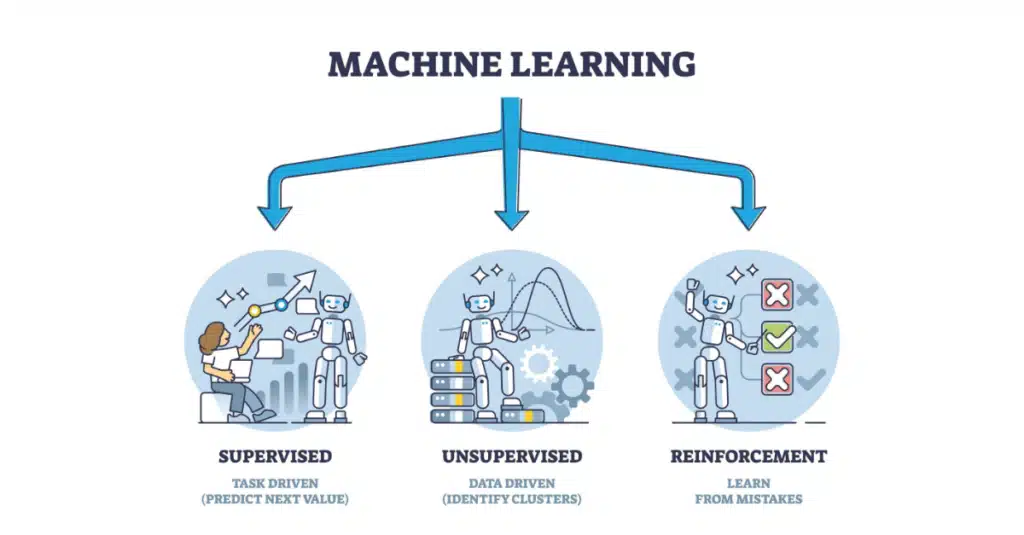
- Supervised Learning: Data is labelled to train the model (dogs, cats, spam mail detection)
- Unsupervised Learning: Deal with unspecified data to find out hidden patterns.
- Reinforcement Learning: It’s like loop learning, where the model learns from its environment by performing tasks, failing at them, trying again, and then improving the outcome.
- Self-supervised Learning: Where the model uses its own data as teacher and teaches itself. It is a key method in modern AI and LLMs.
- Semi-supervised Learning: A mix of labelled and unlabelled data is provided. The model learns from its own patterns and outcomes, which are gained from labelled data.
Where Machine Learning is Used?
The applications of machine learning include anomaly detection, house price prediction, product recommendation, medical diagnosis, self-driving cars, fraud detection, speech recognition, predictive analytics, email spam detection, and more.
How Machine Learning Powers Large Language Models?
LLMs are an arm of machine learning, and machine learning is the base that trains LLMs on huge amounts of data through its branch of deep learning. The key ML concepts, such as tokenization & word embeddings, transformer architecture & self-attention, fine-tuning, and many more, are the base of large language models.
Related: LLMO SEO Guide: Make Content Discoverable by AI
What are Large Language Models?
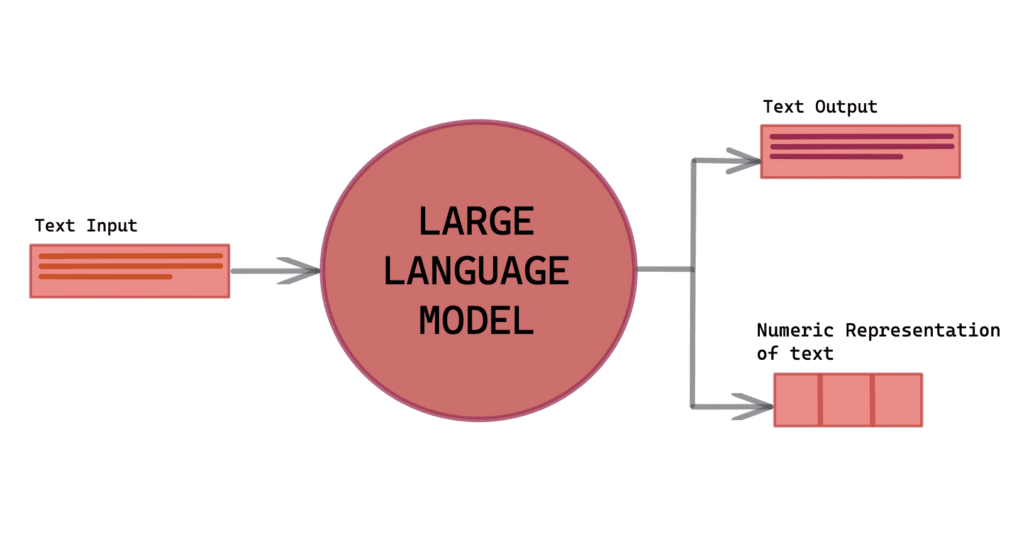
In simple words, LLMs are a jack of all trades, unlike traditional ML models. LLMs are a special type of deep learning model and are a subset of machine learning. They are trained on huge amounts of data, almost all data available on the internet, and of all types, whether it is text, images, sounds, or time series data. Making it a key handler of NLP solutions (Natural Language Processing). Large language models, such as GPT, BERT, LLaMA, and Claude, are here to mimic human behavior and provide human-like output.
Types of LLMs
- Autoregressive Models: They predict the next word in the sequence.
- Masked Language Models: Capable of predicting missing words in a sentence.
- Encoder-Decoder Models: Basically encoder extracts input and learns an embedding for predictive tasks while the decoder generates the output, and both do the work in sequence.
- Multimodal Models: Models built to handle all formats of input together, such as audio, video, visual, text, and audio-visual.
- Instructional-tuned Models: A process is used to make models more useful and predictable by bridging the gap between next word prediction (base function) and a specific outcome for the user.
Where are Large Language Models Used?
LLMs are everywhere today, from being chatbots and virtual assistants to full-proof business intelligence. They are applicable in various industries like content creation, education, coding, information retrieval, translation, art, and much more.
Why are LLMs Unique?
LLMs are unique because they are the jack of all trades in the literal sense. They are loved, widely used, and talked about due to their ability to handle diverse data and give diverse outputs, and perform numerous tasks efficiently. They are trained on billions of parameters for a better understanding of context, semantics, and syntax than traditional models.
Another key aspect that makes LLMs unique is their generative capabilities. Let’s understand that better.
Related: What Is Paid Search Intelligence? Know All About It
Machine Learning Vs Generative AI
Machine learning is about prediction, not creativity. Computers learn from given data sets to analyze, classify, and give forward-looking outputs with the help of machine learning. Whereas, generative AI goes the next mile by creating new content from the input, for example, give it a text prompt describing a desired visual, and it will create an image as per your expectation, or write a whole code for you if you want it.
And LLMs are a subset of generative AI, which are highly focused on generating human-like text. Whereas Gen AI is a whole ecosystem for creating multimodal outputs.
Why do you need to understand these models & ethical concerns in AI models?
In an experiment, there were numerous pictures of dogs and wolves provided to AI models to differentiate between the two. As an output, yes, AI could identify, but it misinterpreted one of the huskies as a wolf, and researchers came to know that the algorithm identified the snow instead of the actual faces of wolves. That is why it is important to understand how the artificial intelligence models work and on what basis they operate and produce outputs.
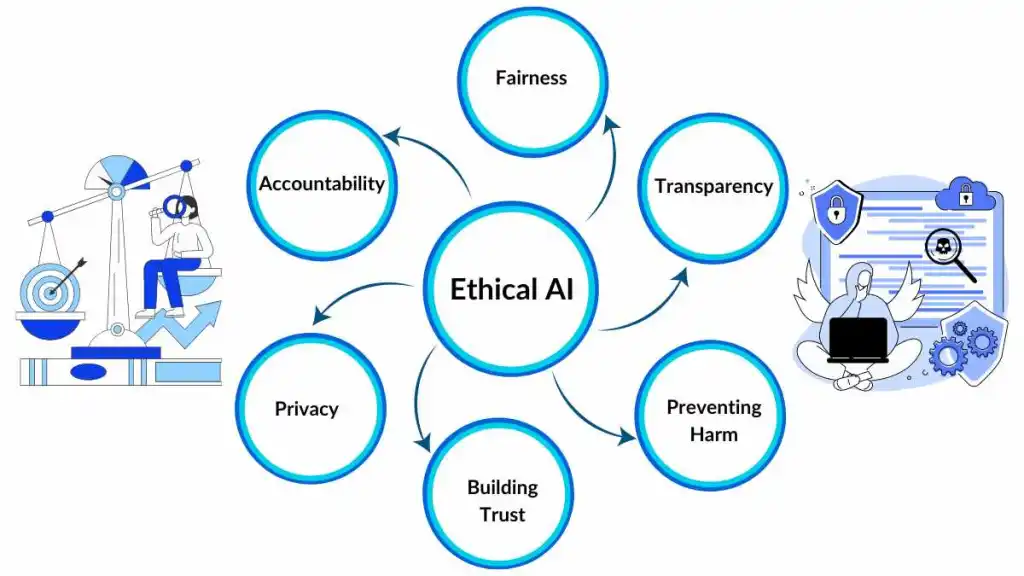
There are several reasons why we need to probe deep into the working of AI systems and models, and one of the key reasons is ethical concerns in ongoing tech advancements. These include concerns like misinformation, security, and privacy risk, as they are trained on huge amounts of personal data as well, for the customization of outputs.
Job displacement and bias are other ethical concerns in the emerging AI era. Also, when AI makes mistakes, who is to be held accountable?
How Do LLMs Understand Human Language?
Many wonder how a machine, or say a device, can behave like humans or offer the same warmth and understanding in conversation as humans. So technically, LLMs don’t understand human language. LLMs simply use logics and mechanics to figure out patterns in sentence formation and ideation, which they have learned from corpora of text provided as training data.
Over time, being trained on billions of parameters and examples, LLMs’ grammar, tone, and even a pinch of reasoning, just like traditional models, predict likely words in a sentence.
Epilogue
Machine learning is the traditional base on which modern large language models are built. Various ML techniques are smartly amalgamated to provide modern and comprehensive NLP solutions. Together, both technologies are rethinking how we interact with technology and becoming the bridge between data-driven learning and real-world intelligence. Which depict the collaborative approach of logic, human-like reasoning, technicality & practicality towards solving issues in the real world.
Therefore, after understanding machine learning and LLM comparison, we can say that ML is the master of one, and LLM is the jack that makes every master play smarter and empowers them to work in a more efficient, comprehensive, and collaborative way.
Related: What Is Android System Intelligence? Features, Privacy & Full Guide