



What’s next? What lies in the future? Can we make a house on the moon? Will humans date robots in the future? Will AI replace all jobs? We are driven by the urge to know what’s happening in the future, and thanks to human intelligence, we are close to answering some of these questions. But do you know that with the help of this prediction power, you can save your business from huge losses even before they occur? And this technology is called predictive maintenance software.
In this reading, I will take you through how it works and all about it.
What Exactly is Predictive Maintenance Software?
It is a data-driven system built on predictive analytics techniques to continuously monitor and optimize the performance and lifespan of equipment through real-time asset assessment. This software can identify and address issues before they occur. Also, it can sense and figure out any upcoming risks involved or potential issues by understanding the current state of the machinery.
How does it work?
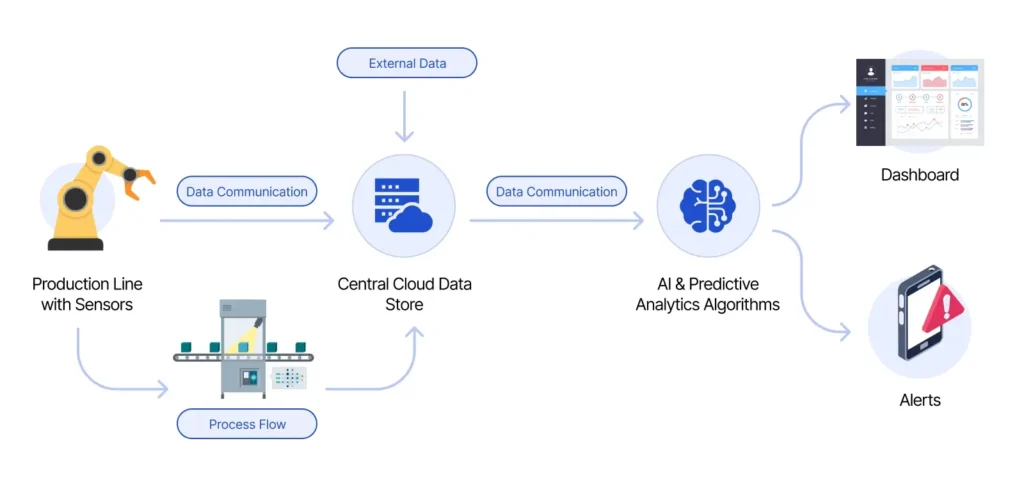
The system makes good use of techniques from data analytics, machine learning, and the Internet of Things (IoT). All these help in gathering and processing real-time data, such as temperature, pressure, and vibration from sensors. The data is collected in a cloud-based AI-enabled enterprise asset management (EAM) or computerized maintenance management system (CMMS).
Then, artificial intelligence and machine learning models make a picture of the current condition and alert if any.
Predictive Maintenance System Vulnerabilities
Since it is a cloud-based maintenance system, there are several challenges involved in its functioning.
- The system collects data from IoT sensors, therefore the sensors must be secured, as there is a risk of sensor tampering.
- Inaccurate and poor-quality historical data can result in inaccurate predictions.
- Integration is one of the most common challenges as traditional machinery has to blend smoothly with new artificial intelligence tools. Also, many organizations rely on older ERP or SCADA system security.
- The system requires a continuous flow of data in real-time to work efficiently, any delay or hindrance can result in poor predictions and inaccurate system reliability estimates.
- Skill gap is also one of the major challenges as these new systems require expertise in data science, AI, and domain knowledge.
- There is a lack of standardization across industries as different machines, vendors, and protocols create complications.
- Predictive maintenance software security is also one of the major concerns, as weak network protocols can give entry points to hackers.
Applications of Predictive Maintenance Software
Predictive maintenance systems are widely used across industries in today’s time. Let’s discuss some use cases around us:
1. Aviation
Predictive maintenance is used on a larger scale in aircrafts to forecast engine failures, landing gear, and other critical systems. Airlines highly rely on PdM to refine safety protocols, reduce delays, and optimize maintenance schedules.
2. Oil and Gas
The ultrasonic testing sensors are capable of picking up high-frequency signals that can go unnoticed by the human ear. This frequency detection helps in identifying leaks in compressed air or gas systems, electrical discharge, or monitoring lubrication quality in bearings.
3. Infrared Imaging (Thermography)
Temperature anomaly detection and heat signatures can be easily caught by infrared cameras in electrical systems, mechanical parts, and insulation. And this is extremely important for electrical panels, transformers, HAVC systems, and even production lines to check on overheating or failing connections.
4. Manufacturing & Industrial Environments
Speaking of this industry, heavy machinery plays a key role here, and even a small inconvenience in their operation can cause heavy losses. So vibration analysis is a technique used on equipment like motors, pumps, and gearboxes. Which helps in spotting changes or abnormalities in vibration patterns can help pin down issues such as bearing wear, imbalance, misalignment, or breakdown in machinery.
5. Healthcare
Equipment such as MRI & CT scanners, ventilators, sterilization equipment, infusion pumps, and diagnostic equipment requires careful maintenance of elements like temperature, accurate pressure, airflow, image clarity, and signal interference. Therefore, predictive maintenance helps to recognize any anomalies or gaps in the above operations.
Predictive vs Preventive vs Reactive vs Corrective
To ensure the best equipment reliability and avoid breakdowns or operational downtime, there are different maintenance systems available. Let us look at the use of each one.
| Type | Predictive Maintenance | Preventive Maintenance | Reactive Maintenance | Corrective Maintenance |
|---|---|---|---|---|
| Definition | The maintenance is followed by a continuous flow of data and conditioning monitoring. | Preventive maintenance focuses on scheduling repairs and maintenance checks at regular intervals. | It works after a failure occurs, it is basically a system designed to fix the damage done. | Corrective maintenance systems get to work as soon as a fault is detected, and it focuses on the root cause of the problem. |
| Approach | The approach is proactive, and the system is condition-based. | The approach is proactive, and the system is time-based. | The approach is reactive, and the system is run-to-failure. | The approach can be reactive or proactive, and the system is fault-based. |
| Technology Used | Uses technology like advanced IoT, artificial intelligence, and machine learning techniques. | Uses basic manual scheduling techniques. | After failures, technicians use diagnostic tools, CMMS, and monitoring devices to log or track repairs. | It has low to moderate technicalities, basic inspection tools, and conditioning monitoring is used. |
| Implementation Time | It is a long process of setting up monitoring tools, data collection, and analysis systems. | Implementation length is medium as it needs scheduling and routine checks. | Immediate implementation, as it requires no preparation until equipment failure. | Implementation length is defined by MTTR ( Mean Time to Repair), and the duration is not fixed. |
| Skills | Skill requirement is high, requiring data science and domain expertise. | Moderate skills requirement level. | Low | Moderate |
| Example | Replace a part of the heating in the electrical panel. | Change the air filter every 6 months. | Fix a motor after it burns out. | Repairing a worn-out bearing after inspection. |
Conclusion
We discussed that predictive maintenance software is widely used across industries and how it can save time, money, and resources by making predictions about future risks and identifying issues. This cloud-based maintenance system has turned out to be super beneficial in healthcare, aviation, manufacturing, and more to save the day from big risks and failures.
Though it has some challenges and vulnerabilities like data safety issues, machine learning model inaccuracies, skill gap, long-term cost, integration with traditional systems, and more. We also learned how different types of maintenance systems pinpoint different issues and offer tailored solutions. Therefore, to stay ahead, you need to have an idea about what can happen next, and that’s where predictive maintenance systems will serve you.
Related: From Raw Data To Revolutionizing Decisions: DAaaS Explained