



As per the Digital 2026 Global Report by byyd, the total of 6.04 billion people represent the global internet audience with a penetration rate of 73.2%. With this bolstering growth in the use of smartphones, programmatic advertising spend has reached $716 billion in 2025 and is growing by 10% with +$65 billion YoY.
Your ad can be the best out there, with perfect content, brilliant copy, visuals and everything. But if it is not at the right time, right place, in front of the right audience, then you can’t expect the desired results. That is why you need programmatic advertising in the growing age of digitization and data-driven culture.
Struggling with ad targeting and wasted budget? Programmatic advertising might be the solution.
In this blog, we will break down everything you need to know about programmatic ads and how to use them in the best way possible.
What is Programmatic Advertising?
It is a modern-day method of planning and buying media; it is a part of ppc marketing where softwares buying digital advertising. The old way was requesting proposals, tenders, quotes, and negotiations, but here, software uses algorithms to make the buying and selling decisions of online display space.
Understand this with a simple example:
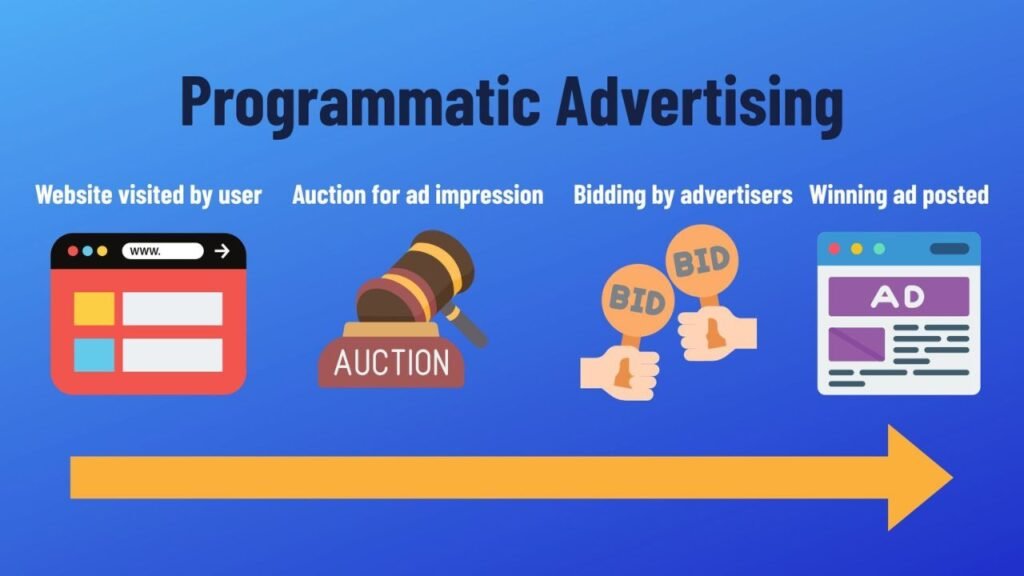
Assume you searched for a watch and opened a website. The website holds a space to place ads, like pop-up ads you see or banner ads, etc. And several watch brands will bid for that ad space. Now only relevant ads will be visible to you, and all this is done in less than a second.
Programmatic ads work on a system that makes users see only ads they are interested in, or possibly can take a CTA on those ads.
Main Components of Programmatic Advertising
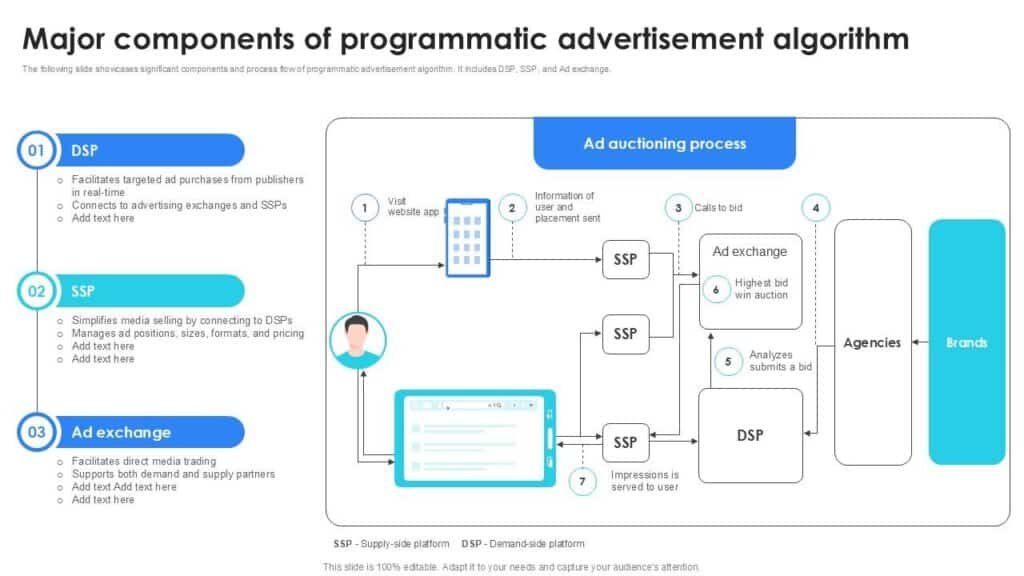
1. Demand-Side Platform (DSP)
It is a tool for advertisers from which brands and companies purchase ads/ad spaces. It uses advanced tech such as real-time bidding. They help advertisers figure out what they want and should target, considering age, interests, and browsing history.
2. Supply-Side Platform (SSP)
It is a helping arm for publishers, and it acts as a manager for them. It allows publishers to sell their ad space at the best deal and find the highest bidder using DSPs. This is good for issuers looking to generate revenue from websites and digital assets.
3. Ad Exchange
You can consider this as a Wall Street of ads, a marketplace where ads are bought and sold. It is the connecting point between DSP and SSP. It makes sure all get a fair chance and the best targeted ad placements as per need.
4. Data Management Platforms (DMP)
This component is responsible for collecting and understanding data that is helpful in deciphering what must be shown to whom. These highly analytical platforms offer deeper insights to advertisers about their audience, user data, and what are their pinpoints.
5. Real-Time Bidding (RTB)
It is the process of instant bidding, which is done in milliseconds. And here it is decided what ad must be shown to which user.
Flow of System
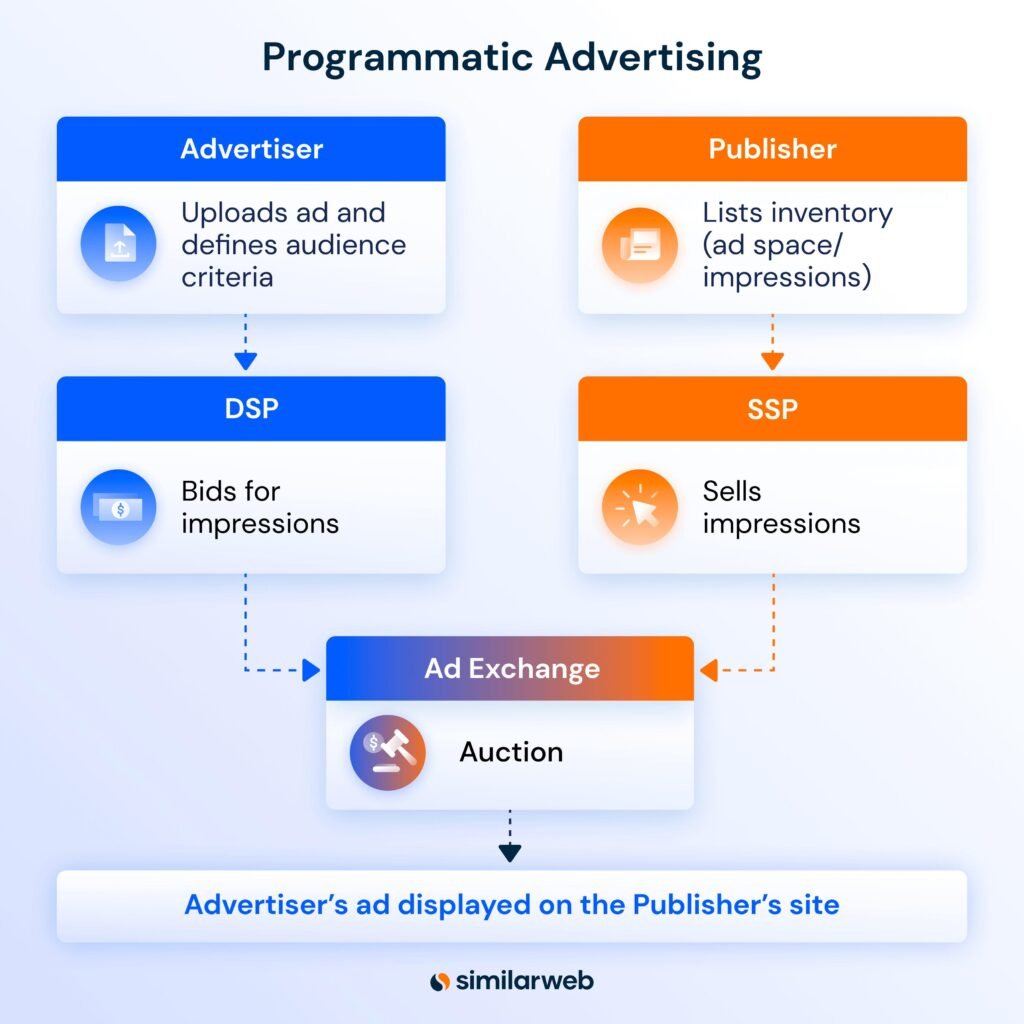
If we talk about how it exactly works, the technology behind this ad system is machine learning, cookies and tracking, real-time systems, big data processing, and APIs.
User → SSP → Ad Exchange → DMP (data check) → DSP (bidding) → RTB → Ad Placed & displayed
Types of Programmatic Ads
1. Private Market Place (PMP)
It is similar to RTB (real-time bidding) as it takes place in a bidding fashion; the only difference is that only selected advertisers can bid.
- A user loads where ad units spark a real-time auction, and later DSP allows only pre-selected advertisers with the help of a time-sensitive deal ID. The floor price is set by publishers for the bidding to begin, and at last, the highest bidder wins and gets their ad served to the user. It is competitive for publishers to get access to PMP auctions.
2. Preferred Deals
As the name suggests, in this process, publishers prefer some advertisers and set aside ad placements for their use exclusively. It is a mutual benefit for advertisers and publishers, as the preference is set after data analysis. The deals have an agreed-upon fixed price/CPM rate.
They are also known as programmatic non-guaranteed, unreserved fixed rate, or spot buying. As bidding from the advertisers’ end is non-guaranteed.
- When a user loads a web page, a request is sent to the advertising network, and the chosen ones get the first look. If it is denied by them, then later the ad unit is sent to open auction.
3. Programmatic Guaranteed
It is a traditional media buying system with some advanced AI tech is used for automating the request for proposal (RFP) and serving & tracking of ads. It is a one-on-one deal between publishers and advertisers.
Advertisers get premium ad inventories, fixed pricing, and better audience targeting and publishers can fill premium inventory at some of the highest rates in the industry. It is also known as automated guaranteed or programmatic direct.
- Bloggers & Advertisers make a deal with a set price for a guaranteed inventory volume. And the blogger serves advertisers’ ads in set-aside premium inventory with a negotiated price/date.
Formats of Programmatic Ads
| Format | Description | Key Feature | Appearance | Use Case |
| Display Ads | These are non-motion or animated banner ads | They have simple visuals with minimal cost | You can spot them on websites and apps | E-commerce banners displaying discounts |
| Video Ads | Ads in the video format | They often have high engagement and a storytelling approach | Featured on YouTube, OTT platforms | Skippable ad before a video |
| Native Ads | Designed to match the platform content | Ads are non-intrusive, a content-like approach | Seen on news sites, blogs | A sponsored article |
| Mobile Ads | Ads specifically optimized for mobile screens | Offer location-based targeting | Mobile applications, mobile web | In-app ads in games |
| Rich Media Ads | Interactive ads made using animation/video | The main feature is user friendliness and user interaction, like you can expand the ads or swipe them | Can be seen on websites, applications | Expandable car ad with features |
| Audio Ads | These ads are only made of audio | For screen-free engagement | Audio music apps, podcasts | Ads between songs or radio ads |
| In-App Ads | Ads inside the mobile apps while operating them | Highly personalized | All phone apps, including games, social media, etc | Reward ads in games or editing apps |
Best Tips to Use Programmatic Advertising
Everything has a roadmap to proceed, and so does a programmatic advertising strategy. Consider the following factors while you work on this type of ad plan to gain the maximum results and increase your ROI.
Learn about your market
As a marketer, it is a crucial step to research and learn about the new arena of advertising when entering it. You need to understand terms, ideas, and competition. The better you prepare, the better you will be able to stay ahead of the competition.
Set goals
Use existing data to comprehend the type, format, and ways of advertising you need to build an effective & efficient advertising strategy. This will also help you figure out goals and what to expect.
Decide what you wish to achieve, it can be overall digital sales, build brand authority, increase engagement, push a particular product or service, raise signups, customer retention, or any other.
Do not neglect the human touch
Programmatic advertising is all about data sets and highly advanced tech such as ML, algorithms, automation, and more. This does not mean that you should forget about the manual touch needed. Even to run the systems to their optimum levels, you need skilled people who know the clear decrees of automation and human involvement.
Follow safety measures
This ad system runs on algorithms that can lead to ad placements on inappropriate sites. Hence, be careful of harmful content or fake news that can risk your brand reputation.
Use features like blacklisting and whitelisting for safe and secure operations. If dealing with an ad agency, make sure they avoid poor content and sensitive platforms.
Real-World Use Cases of Programmatic Advertising
1. Google
Google wanted to show how advanced targeting and automation can cut costs while expanding reach simultaneously. The aim is to strengthen the brand perception by pointing out that ads are not just seen but remembered.
They did all this with highly data-driven digital marketing strategies: used a combination of first & third party data for better targeting, used performance feedback, recycled data to improve audience reach and frequency.
It resulted in 30% increased reach, 30% lower CPM, and brand recognition skyrocketed by 50%.
2. Lacoste
It is one of the top case studies for programmatic advertising to learn from. They used display ads, personalized content, and drove sales.
The customer data, audience segmentation, continuous creatives, formats, and ad placements were optimized. Use of real-time adjustments maximizes campaign efficiency and ROI.
Resulted in 19,749,380 impression generation and 2,290 sales across key markets.
3. Audi
When Audi launched its customizable Q2 SUV, their goal was to boost conversions by delivering highly personalized, relevant ads to car enthusiasts.
They collaborated with Google, making use of display and video 360, and used floodlight tags for retargeting and high-intent customers. They even integrated a car configurator to capture people’s style preferences.
Their efforts resulted in 400% increased in conversion rate compared to traditional buying. Also, dynamic creatives proved to be 2x more effective than static ones.
Bottom Line
Programmatic Advertising is the buying and selling of digital ads using intelligence and highly advanced tech such as AI, algorithms, and automation. The process is highly data-driven and works on some key elements such as DSP, RTB, SSP, Ad Exchange, and Data Management Platforms.
There are a few types of this ad, as we discussed in the blog; each has its own pros and cons and caters to different needs. We have also shared how to best leverage this ad system and gain maximum results. We also discovered how some of the biggest brands used this system to increase their sales, conversions, cut CPM, soar brand perception, and more.
The data clearly displayed the towering global markets of programmatic advertising. To stay relevant in the upending online place, it is important to adapt to this new way of marketing.
Also Read: What is Market Intelligence? Your Key to Unlock Success This Year